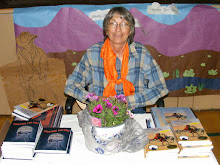
As anyone can see who reads this blog, I hate writing about myself. I put it off as long as I can, and ignore the whisperings of my guilty conscience. I know I am not the only writer who struggles with publicizing her work--many writers are, by nature, introverts, and we would much rather bury ourselves in writing or writing-related projects, guarding our privacy. At the same time, I enjoy doing presentations and talking about my books, so there is a tension there.
Rereading my last blog post, about a student writing activity last school year that didn't go as well as I had hoped, reminded me that later that year, I had just the opposite experience. One day I was subbing and a girl asked me how to write a book. An idea popped into my head, and, seeing we had some extra time, I decided to use her question as a class activity.
I wrote a basic story idea on the board, then we played with it. The class helped me add detail after detail until we had the whole board covered with possibilities. Not only was it fun and instructive--at recess two teachers came in, saw it and asked me about it, so I explained what we had done. One asked if I could come to her class and do the same activity! So a few days later I popped into her room (which just happened to be my granddaughter's class) for an hour and we did the same thing. Then she used it as a class assignment after I left, to write the story we had outlined.
I found it amazing that the unplanned idea turned out so good that I know I will use it again and again, yet the one I had slaved over did not turn out as well as I had envisioned. This often happens in writing. Books, or characters in books, sometimes take on a life of their own, beyond what you had originally planned.
Showing posts with label teachers. Show all posts
Showing posts with label teachers. Show all posts
Thursday, September 13, 2012

Saturday, January 14, 2012
I've been busy writing for the past month or so, but not on a book. However, it is book-related, and I'm very excited about it.
Twice in the past few years I've given my "Nevada's Ranching History" slideshow presentation at the Nevada Reading Week Conference in Reno (http://www.nevadareadingweek.com). Most of the attendees are northern Nevada teachers and librarians. This year (February 10-11) I will be giving two presentations: the ranch history, and one for aspiring writers called "The Path to Publishing."
I'm expanding the ranch workshop to fit a longer timeslot, so I can fit in things I had to leave out to fit the other shorter timeslot. Then I have to tweak my slideshow to match. The handout includes an abstract and several ag-related pages from the Curriculum Unit of my book, The Orange Slipknot.
The writing workshop will focus on how your life experiences prepare you to be a writer and give you the raw material to get started. There is a short slideshow about how I came to write my book. Then we will discuss marketing and publishing your book, with the information summarized in a handout.
The biggest challenge is the clock--practicing and timing myself, while factoring in the possibility that things will move quicker or slower than I have estimated. I hope to get people talking; they may talk longer than I intend, or not as much, so I need to be able to adjust my presentation accordingly.
I always take my cowboy gear display--saddle, bridles, etc., and I wear my boots, chaps, spurs, hat and wildrag. My book, The Orange Slipknot, and the accompanying Curriculum Unit, will be available for sale, and I get to talk about the upcoming sequel, Starting the Colt--targeted for early 2013.
Twice in the past few years I've given my "Nevada's Ranching History" slideshow presentation at the Nevada Reading Week Conference in Reno (http://www.nevadareadingweek.com). Most of the attendees are northern Nevada teachers and librarians. This year (February 10-11) I will be giving two presentations: the ranch history, and one for aspiring writers called "The Path to Publishing."
I'm expanding the ranch workshop to fit a longer timeslot, so I can fit in things I had to leave out to fit the other shorter timeslot. Then I have to tweak my slideshow to match. The handout includes an abstract and several ag-related pages from the Curriculum Unit of my book, The Orange Slipknot.
The writing workshop will focus on how your life experiences prepare you to be a writer and give you the raw material to get started. There is a short slideshow about how I came to write my book. Then we will discuss marketing and publishing your book, with the information summarized in a handout.
The biggest challenge is the clock--practicing and timing myself, while factoring in the possibility that things will move quicker or slower than I have estimated. I hope to get people talking; they may talk longer than I intend, or not as much, so I need to be able to adjust my presentation accordingly.
I always take my cowboy gear display--saddle, bridles, etc., and I wear my boots, chaps, spurs, hat and wildrag. My book, The Orange Slipknot, and the accompanying Curriculum Unit, will be available for sale, and I get to talk about the upcoming sequel, Starting the Colt--targeted for early 2013.
Friday, November 18, 2011
Something I've been struggling with in my mind for several months is learning how I might make my Curriculum Unit more teacher-friendly by aligning it with the new Common Core Standards. Listening to teachers and reading the school board reports, I hear that now everything in the classroom must be aligned to these standards.
The problem is, I don't even know what the Common Core Standards are or how I might do this. Subbing in various schools, I have picked up on the fact that teachers themselves are struggling to figure out the standards and what to do with them. So how is someone like me going to figure them out? And how important is it that I do this? The more I look into it, the more questions I have and I'm not sure who can even answer them.
I started by asking a few teachers, who seemed to think I was on the right track. Then I turned to the internet to find information. I don't know if I need to find someone to help me, or if I can figure out what I need to know by just digging around on my own. But there's only one way to find out--start digging. I'm already getting brain-strain.
I want The Orange Slipknot and my Curriculum Unit to be useful teaching tools in the classroom. Teachers will be more likely to buy them if the necessary work has already been done for them. As an author who is also working in the school system, I hope to use my knowledge and experience to help me market my book to teachers. Being an author is more than just writing a good story--there is lots of work to do after the book gets published.
The problem is, I don't even know what the Common Core Standards are or how I might do this. Subbing in various schools, I have picked up on the fact that teachers themselves are struggling to figure out the standards and what to do with them. So how is someone like me going to figure them out? And how important is it that I do this? The more I look into it, the more questions I have and I'm not sure who can even answer them.
I started by asking a few teachers, who seemed to think I was on the right track. Then I turned to the internet to find information. I don't know if I need to find someone to help me, or if I can figure out what I need to know by just digging around on my own. But there's only one way to find out--start digging. I'm already getting brain-strain.
I want The Orange Slipknot and my Curriculum Unit to be useful teaching tools in the classroom. Teachers will be more likely to buy them if the necessary work has already been done for them. As an author who is also working in the school system, I hope to use my knowledge and experience to help me market my book to teachers. Being an author is more than just writing a good story--there is lots of work to do after the book gets published.
Sunday, October 14, 2007
On August 18 I wrote some comments about how many Americans don't see the relationship between ranching and our food supply. I recently came across this quote in Range Magazine, from the article "Healing the Land with Livestock":
"About 98.5% of Americans are city or suburban based and have no connection with the production of the food they consume. Only 1.5% of the American population has anything to do with producing food."
This is one of my motivations for writing about ranching and Nevada. Our nation's roots are in agriculture, but in the last several generations, most lifestyles have become distant from farming or ranching. Food comes from the grocery store, not outside the back door.
I grew up in the suburbs of Sacramento, California. When I first met my husband, I remember asking him what was in that little building behind his barn. He said that was his pumphouse. I said, "You have your own WELL?" He laughed and asked where I thought water came from? I said, "From pipes under the street!" That really made him laugh! I had a college education and I knew that water came from underground, but I had never known anyone who actually had a well. Everyone had "city water" and got a water bill from the city. I was surprised to learn that people with wells don't get water bills; electric pumps pump the water to their homes, so instead of a water bill, they just have a bigger electricity bill.
Because few families raise animals for food, few kids see animals killed to provide their meat. At the same time this trend was developing, kids began watching cartoons with cute talking animals. The thought of killing "cute" animals and eating them horrifies many kids. Farm and ranch kids see, accept and understand this fact of life. Many city kids grow up with an unrealistic view of our food supply, then fall prey to the propaganda of the environmentalists who paint ranchers as enemies of the land. I hope that as I show city kids the ranching lifestyle in a fictional setting, they will come to understand not only our American agricultural heritage, but the need for ranching today.
As far as the progress of The Orange Slipknot, I finally finished the curriculum unit. I am so excited about the thought of classrooms full of kids reading this book and learning about Nevada, ranching, and cowboys! The curriculum unit provides teachers with many questions, activities and writing assignments. It was also very exciting to contact all my friends and announce that the book is now on sale! Many people are already placing their orders.
"About 98.5% of Americans are city or suburban based and have no connection with the production of the food they consume. Only 1.5% of the American population has anything to do with producing food."
This is one of my motivations for writing about ranching and Nevada. Our nation's roots are in agriculture, but in the last several generations, most lifestyles have become distant from farming or ranching. Food comes from the grocery store, not outside the back door.
I grew up in the suburbs of Sacramento, California. When I first met my husband, I remember asking him what was in that little building behind his barn. He said that was his pumphouse. I said, "You have your own WELL?" He laughed and asked where I thought water came from? I said, "From pipes under the street!" That really made him laugh! I had a college education and I knew that water came from underground, but I had never known anyone who actually had a well. Everyone had "city water" and got a water bill from the city. I was surprised to learn that people with wells don't get water bills; electric pumps pump the water to their homes, so instead of a water bill, they just have a bigger electricity bill.
Because few families raise animals for food, few kids see animals killed to provide their meat. At the same time this trend was developing, kids began watching cartoons with cute talking animals. The thought of killing "cute" animals and eating them horrifies many kids. Farm and ranch kids see, accept and understand this fact of life. Many city kids grow up with an unrealistic view of our food supply, then fall prey to the propaganda of the environmentalists who paint ranchers as enemies of the land. I hope that as I show city kids the ranching lifestyle in a fictional setting, they will come to understand not only our American agricultural heritage, but the need for ranching today.
As far as the progress of The Orange Slipknot, I finally finished the curriculum unit. I am so excited about the thought of classrooms full of kids reading this book and learning about Nevada, ranching, and cowboys! The curriculum unit provides teachers with many questions, activities and writing assignments. It was also very exciting to contact all my friends and announce that the book is now on sale! Many people are already placing their orders.
Subscribe to:
Posts (Atom)