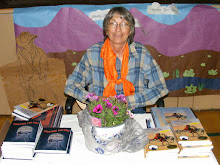
During a recent subbing job, while assigning an article on environmentalism, I was reminded of one of several reasons I am writing books.
When our boys were little (if you know them, you'll find it hard to believe they were ever little!), my husband and I moved to northern Nevada--ranching country. I was fascinated with ranch and cowboy life, so different from my more urban background. I realized many kids have no idea where their food comes from or the importance agriculture plays in our lives. Food doesn't come from the store--it is produced by farmers and ranchers. Cowboys aren't just colorful characters in the Old West, movies, or rodeos, but play in important role in beef production.
Having been a bookworm all my life, I read piles of books to my little ones, hoping to instill in them the love of books. Many were engaging and well-written, but some made me wonder if I couldn't have written a better one myself! I began to toy with the thought of someday writing books for children.
Fast forward a few years. My boys are bringing home papers from school with a strong environmentalist slant, sometimes (as in the assignment I mentioned above) with a blatant anti-farming/ranching element. My pro-agriculture feelings were kindled even further.
By this time I was writing and selling stories and articles to magazines and felt ready to attempt a book. I had read that nonfiction was a good way for a new author to break into the publishing game. I fumbled around with a few fruitless endeavors before it occurred to me that I could probably appeal to more kids in a fiction format, weaving background information into my story.
Not only did this approach prove successful, but during author talks I can bring out the agriculture angle even more, as part of an entertaining slideshow. The curriculum unit, while primarily integrating elements of reading and writing, helps teachers use the agriculture focus as a science connection and the Nevada ranching focus as a social studies connection.
Unfortunately, there was no time the other day to take the time to talk with my class about environmentalism, its agenda, and how it is pushed in the classroom and elsewhere. But through my books, I am doing what I can to educate kids about agriculture and the unique ranching sub-culture of the West.
Showing posts with label cowboy. Show all posts
Showing posts with label cowboy. Show all posts
Saturday, March 12, 2016

Wednesday, July 31, 2013
.
Some writing is hard work, but some is serendipity. Yesterday I started to create a curriculum unit activity for a science connection, then remembered that many years ago, I created something similar that is still in my old files. I pulled it out, spent the day revising it, and voila! Just what I needed!
One of the rules of writing is, "Write what you know and care about," so I started out years ago writing about Nevada, cowboying, and ag-related topics. Much of what I came up with in my early writing days never sold, but waited patiently for the right opportunity to jump out and find its niche. I love seeing how some of my original ideas, after aging a bit, found new angles and became part of The Orange Slipknot or Starting the Colt. As I recently read in Ecclesiastes 3:1, "there is an appointed time for everything."
One of the rules of writing is, "Write what you know and care about," so I started out years ago writing about Nevada, cowboying, and ag-related topics. Much of what I came up with in my early writing days never sold, but waited patiently for the right opportunity to jump out and find its niche. I love seeing how some of my original ideas, after aging a bit, found new angles and became part of The Orange Slipknot or Starting the Colt. As I recently read in Ecclesiastes 3:1, "there is an appointed time for everything."
Saturday, July 6, 2013
The deeper I get into the curriculum unit I'm creating for Starting the Colt, the more fun I'm having. At first it was hard work to determine and formulate the right kinds of questions, but now, over half way through, the questions are becoming more obvious to me, as I find them building on earlier questions. For each chapter, there is a page of writing/discussion questions and journal prompts, then a vocabulary page.
I'm especially enjoying the vocabulary pages, because I find words interesting. In fact, I start with the vocabulary page, reading through the chapter looking for any words or phrases to focus on. I find that usually my list breaks down into two groups: horse or cowboy terminology, and interesting words. I don't start with the question page because that "seems" like harder work. But in the process of gathering up my vocabulary words, I "discover" the chapter questions without really having to work at it.
Vocabulary activities include glossary and dictionary, context clues, similes, idioms, slang, synonyms and antonyms, root words, origins, parts of speech, domain-specific language in several domains, etc. Right now I'm in the middle of an interesting rabbit trail that started with double-ought sized horseshoes and turned into a math connection page on ought/aught/nought/naught. Now I need to organize all that information and make it interactive.
I'm especially enjoying the vocabulary pages, because I find words interesting. In fact, I start with the vocabulary page, reading through the chapter looking for any words or phrases to focus on. I find that usually my list breaks down into two groups: horse or cowboy terminology, and interesting words. I don't start with the question page because that "seems" like harder work. But in the process of gathering up my vocabulary words, I "discover" the chapter questions without really having to work at it.
Vocabulary activities include glossary and dictionary, context clues, similes, idioms, slang, synonyms and antonyms, root words, origins, parts of speech, domain-specific language in several domains, etc. Right now I'm in the middle of an interesting rabbit trail that started with double-ought sized horseshoes and turned into a math connection page on ought/aught/nought/naught. Now I need to organize all that information and make it interactive.
Wednesday, June 19, 2013
Writing a curriculum unit, like writing a book, is hard work, but fun work! Word games, like crosswords, always fascinated me, as well as reading about origins of interesting words, phrases and idioms. This background gives me ideas for the vocabulary section of each chapter. Exploring idioms and opening up the world of cowboy slang to non-ranching kids is a challenge I really enjoy.
Having learned about the Common Core Standards and DOK levels, I'm coming at the chapter questions from a different angle than when I started the CU for The Orange Slipknot (before I revised it for the Standards). Instead of majoring in recall/retelling questions, I have almost none of those; the questions tend more in the direction of what you would discuss with a writer's group--just on a fourth grade level! Teachers want their students to learn how to think about literature. I am trying to help them understand how an author crafts a book--to talk about theme, plot development, character development, foreshadowing, etc.
Having learned about the Common Core Standards and DOK levels, I'm coming at the chapter questions from a different angle than when I started the CU for The Orange Slipknot (before I revised it for the Standards). Instead of majoring in recall/retelling questions, I have almost none of those; the questions tend more in the direction of what you would discuss with a writer's group--just on a fourth grade level! Teachers want their students to learn how to think about literature. I am trying to help them understand how an author crafts a book--to talk about theme, plot development, character development, foreshadowing, etc.
Tuesday, October 20, 2009
In getting back into the sequel which I started years ago, I have used several writing strategies. First I reread, edited, cut and changed much of what I had. I looked at the pacing and decided my chapters were too long. I hope to attract reluctant boy readers, and my school experience the last few years convinced me that shorter chapters would make the book easier to handle. I cut almost every chapter in the middle, which meant I had to rethink the beginnings and endings of each chapter. I also divided the rest of my synopsis up into chapters, now that I know about how much needs to happen in each chapter. A check of my word count and a comparison to TOS showed me that I may be close to 2/3 done. It's time to start picking up the pace of the story. I made a timeline of events and chapters so I know what day I want the story to end on and what will take place on each of the last few days.
Next, I realized that the plot needed a little more focus. I reread some plotting guidelines, which reminded me to ask myself: what does the main character need or want, and what is standing in the way? What complications arise, so that it appears he will not be able to get what he wants? Thinking in these terms helped me to focus on what exactly Ben's fears and desires are, and what specific developments I could create to frustrate his desires, which increases suspense. This type of planning helped me to come up with ideas. And once I knew where I needed the story to go, I was able to go back to what I had already written and throw in a little foreshadowing--hints or shadows of what is to come.
The third strategy I used was to go back through my writer's notebook, which I hadn't looked at since I was finishing TOS. My notebook is full of cowboy sayings, cowboy stories, and other sayings and stories that I have collected, mostly from my husband and two sons. When I saw something that "grabbed" me, I would spend some time trying to figure out how I could weave that into the story. This would even give me ideas for adding to the plot or adding to scenes I had already written. Adding elements from real incidents gives more depth, detail, believability, and humor--"true fiction." As I wrote in an earlier post, writing is often like working a giant puzzle. Sometimes it's frustrating when you get stuck; then you find one little piece you need, and suddenly other little pieces start to jump out at you and fit together.
Next, I realized that the plot needed a little more focus. I reread some plotting guidelines, which reminded me to ask myself: what does the main character need or want, and what is standing in the way? What complications arise, so that it appears he will not be able to get what he wants? Thinking in these terms helped me to focus on what exactly Ben's fears and desires are, and what specific developments I could create to frustrate his desires, which increases suspense. This type of planning helped me to come up with ideas. And once I knew where I needed the story to go, I was able to go back to what I had already written and throw in a little foreshadowing--hints or shadows of what is to come.
The third strategy I used was to go back through my writer's notebook, which I hadn't looked at since I was finishing TOS. My notebook is full of cowboy sayings, cowboy stories, and other sayings and stories that I have collected, mostly from my husband and two sons. When I saw something that "grabbed" me, I would spend some time trying to figure out how I could weave that into the story. This would even give me ideas for adding to the plot or adding to scenes I had already written. Adding elements from real incidents gives more depth, detail, believability, and humor--"true fiction." As I wrote in an earlier post, writing is often like working a giant puzzle. Sometimes it's frustrating when you get stuck; then you find one little piece you need, and suddenly other little pieces start to jump out at you and fit together.
Saturday, October 20, 2007
The illustrations are completed and the final editing and proof-reading are in progress. The next step is printing. The Orange Slipknot will be out by Christmas!
As the publication date looms closer, both the publisher and I have started marketing the book. This involves contacting potential buyers as well as making updates to both our websites to facilitate ordering.
Many authors or would-be authors do not realize that writing books requires the author to do a certain amount of publicity and marketing. Even if a large publishing house with a marketing department is handling your book, you need to be as involved as possible, if you want to sell a lot of books.
Writing is only half of being an author. Once you have finished your manuscript, you need to be knowledgeable about how to market your book to publishers. The course I took from the Institute for Children's Literature taught both writing and marketing. Many aspiring authors I have talked to have no idea what to do once they finish their manuscript. There are many books and websites that explain how to find publishers and how to contact them. If you fail to do your homework, randomly select publishers, and do not package your submission in the required manner, you stand very little chance of your manuscript even being looked at, much less published.
Once you have sold your book, you need to help market your book to the public. I have been collecting information on this subject for years and have a file folder of clippings from writers' newsletters and articles. At one point I considered self-publishing through POD (print-on-demand); the author pays anywhere from several hundred to several thousand dollars, and publishes without the benefit of the discriminating eye of an editor. There are many such publishers available, and as I researched them, I found that by using them, I would be 100% responsible for publicity and marketing. To prepare myself for that possibility, I began looking for even more information about how to do that. I learned that even a traditionally-published book will benefit from author involvement in the marketing process.
Many writers hope to become famous; I don't. Being a rather quiet, private type of person, I admit I dread the idea of publicizing myself. But I have also learned over the years that I can do many things I didn't think I could do, or even things I don't want to do. Making a website for my book was the first step, which I already knew how to do and which didn't involve face-to-face publicity. Then I designed and printed out bookmarks to give people I talk to. I found a graphic for the top, used some of the text I already had on my webpage, and printed it on orange paper. I designed some flyers which I posted around town on bulletin boards. These projects were time-consuming, but not scary.
I also did a few book talks at the school where I work. I have collected ideas for book talks to schools and to writers' groups ever since I started writing this book, so it wasn't hard to come up with a book talk format. Getting positive feedback from the kids and teachers was encouraging. It was fun to dress up in cowboy hat, chaps, boots, spurs, and wildrag, display some cowboy tack, and talk about cowboys, as well as read from my book and present some writing exercises. This wasn't scary either, but did make me a little nervous. I used to be extremely shy but over the years, through many opportunities, have developed the ability to speak in front of groups. I hope to be able to do some book talks, but since I work five days a week, I'm not sure if or how that might work out.
Book signings and media interviews are the kinds of things I dread. Instead, I prefer collecting business cards from vendors at horse activities who are interested in carrying my book, or searching the web for contact information for schools and homeschoolers. I will gladly drop by stores and gift shops, locally or wherever I happen to travel, or call librarians, to see if they might like to carry my book. I am glad that my publisher already has an established clientele that is interested in her books. I am glad she knows about marketing and distribution. I'm glad I did not choose to self-publish, taking on the financial risk and the huge burden of selling my book.
As the publication date looms closer, both the publisher and I have started marketing the book. This involves contacting potential buyers as well as making updates to both our websites to facilitate ordering.
Many authors or would-be authors do not realize that writing books requires the author to do a certain amount of publicity and marketing. Even if a large publishing house with a marketing department is handling your book, you need to be as involved as possible, if you want to sell a lot of books.
Writing is only half of being an author. Once you have finished your manuscript, you need to be knowledgeable about how to market your book to publishers. The course I took from the Institute for Children's Literature taught both writing and marketing. Many aspiring authors I have talked to have no idea what to do once they finish their manuscript. There are many books and websites that explain how to find publishers and how to contact them. If you fail to do your homework, randomly select publishers, and do not package your submission in the required manner, you stand very little chance of your manuscript even being looked at, much less published.
Once you have sold your book, you need to help market your book to the public. I have been collecting information on this subject for years and have a file folder of clippings from writers' newsletters and articles. At one point I considered self-publishing through POD (print-on-demand); the author pays anywhere from several hundred to several thousand dollars, and publishes without the benefit of the discriminating eye of an editor. There are many such publishers available, and as I researched them, I found that by using them, I would be 100% responsible for publicity and marketing. To prepare myself for that possibility, I began looking for even more information about how to do that. I learned that even a traditionally-published book will benefit from author involvement in the marketing process.
Many writers hope to become famous; I don't. Being a rather quiet, private type of person, I admit I dread the idea of publicizing myself. But I have also learned over the years that I can do many things I didn't think I could do, or even things I don't want to do. Making a website for my book was the first step, which I already knew how to do and which didn't involve face-to-face publicity. Then I designed and printed out bookmarks to give people I talk to. I found a graphic for the top, used some of the text I already had on my webpage, and printed it on orange paper. I designed some flyers which I posted around town on bulletin boards. These projects were time-consuming, but not scary.
I also did a few book talks at the school where I work. I have collected ideas for book talks to schools and to writers' groups ever since I started writing this book, so it wasn't hard to come up with a book talk format. Getting positive feedback from the kids and teachers was encouraging. It was fun to dress up in cowboy hat, chaps, boots, spurs, and wildrag, display some cowboy tack, and talk about cowboys, as well as read from my book and present some writing exercises. This wasn't scary either, but did make me a little nervous. I used to be extremely shy but over the years, through many opportunities, have developed the ability to speak in front of groups. I hope to be able to do some book talks, but since I work five days a week, I'm not sure if or how that might work out.
Book signings and media interviews are the kinds of things I dread. Instead, I prefer collecting business cards from vendors at horse activities who are interested in carrying my book, or searching the web for contact information for schools and homeschoolers. I will gladly drop by stores and gift shops, locally or wherever I happen to travel, or call librarians, to see if they might like to carry my book. I am glad that my publisher already has an established clientele that is interested in her books. I am glad she knows about marketing and distribution. I'm glad I did not choose to self-publish, taking on the financial risk and the huge burden of selling my book.
Sunday, October 14, 2007
On August 18 I wrote some comments about how many Americans don't see the relationship between ranching and our food supply. I recently came across this quote in Range Magazine, from the article "Healing the Land with Livestock":
"About 98.5% of Americans are city or suburban based and have no connection with the production of the food they consume. Only 1.5% of the American population has anything to do with producing food."
This is one of my motivations for writing about ranching and Nevada. Our nation's roots are in agriculture, but in the last several generations, most lifestyles have become distant from farming or ranching. Food comes from the grocery store, not outside the back door.
I grew up in the suburbs of Sacramento, California. When I first met my husband, I remember asking him what was in that little building behind his barn. He said that was his pumphouse. I said, "You have your own WELL?" He laughed and asked where I thought water came from? I said, "From pipes under the street!" That really made him laugh! I had a college education and I knew that water came from underground, but I had never known anyone who actually had a well. Everyone had "city water" and got a water bill from the city. I was surprised to learn that people with wells don't get water bills; electric pumps pump the water to their homes, so instead of a water bill, they just have a bigger electricity bill.
Because few families raise animals for food, few kids see animals killed to provide their meat. At the same time this trend was developing, kids began watching cartoons with cute talking animals. The thought of killing "cute" animals and eating them horrifies many kids. Farm and ranch kids see, accept and understand this fact of life. Many city kids grow up with an unrealistic view of our food supply, then fall prey to the propaganda of the environmentalists who paint ranchers as enemies of the land. I hope that as I show city kids the ranching lifestyle in a fictional setting, they will come to understand not only our American agricultural heritage, but the need for ranching today.
As far as the progress of The Orange Slipknot, I finally finished the curriculum unit. I am so excited about the thought of classrooms full of kids reading this book and learning about Nevada, ranching, and cowboys! The curriculum unit provides teachers with many questions, activities and writing assignments. It was also very exciting to contact all my friends and announce that the book is now on sale! Many people are already placing their orders.
"About 98.5% of Americans are city or suburban based and have no connection with the production of the food they consume. Only 1.5% of the American population has anything to do with producing food."
This is one of my motivations for writing about ranching and Nevada. Our nation's roots are in agriculture, but in the last several generations, most lifestyles have become distant from farming or ranching. Food comes from the grocery store, not outside the back door.
I grew up in the suburbs of Sacramento, California. When I first met my husband, I remember asking him what was in that little building behind his barn. He said that was his pumphouse. I said, "You have your own WELL?" He laughed and asked where I thought water came from? I said, "From pipes under the street!" That really made him laugh! I had a college education and I knew that water came from underground, but I had never known anyone who actually had a well. Everyone had "city water" and got a water bill from the city. I was surprised to learn that people with wells don't get water bills; electric pumps pump the water to their homes, so instead of a water bill, they just have a bigger electricity bill.
Because few families raise animals for food, few kids see animals killed to provide their meat. At the same time this trend was developing, kids began watching cartoons with cute talking animals. The thought of killing "cute" animals and eating them horrifies many kids. Farm and ranch kids see, accept and understand this fact of life. Many city kids grow up with an unrealistic view of our food supply, then fall prey to the propaganda of the environmentalists who paint ranchers as enemies of the land. I hope that as I show city kids the ranching lifestyle in a fictional setting, they will come to understand not only our American agricultural heritage, but the need for ranching today.
As far as the progress of The Orange Slipknot, I finally finished the curriculum unit. I am so excited about the thought of classrooms full of kids reading this book and learning about Nevada, ranching, and cowboys! The curriculum unit provides teachers with many questions, activities and writing assignments. It was also very exciting to contact all my friends and announce that the book is now on sale! Many people are already placing their orders.
Saturday, August 18, 2007
Lately I have been working on the Nevada pages of the curriculum unit. I wrote The Orange Slipknot because I wanted to share my love of Nevada--not the glitz of Las Vegas, but the beauty and uniqueness of buckaroo country. I grew up in California, so Nevada is my adopted state. I was a town girl, not a country girl. I never imagined I would grow up to marry a cowboy and raise my kids 50 miles from a town. Life here was so different from what I had known. My letters home to family and friends were filled with adventures and anecdotes that had them shaking their heads. More than once I was told I should write a book. Those letters contained the seeds of stories to come.
When I started my journey into writing, I began by reading books about writing for children. They all advised, "Write about what you know and feel passionately about." I knew I would write about kids growing up in Nevada. My first piece of writing was called "The Best Thing About Nevada," in which a boy tells about all the things he loves about living in Nevada and cowboying with his dad. I didn't know it then, but it was "Ben" in disguise! So many elements from that essay found their way into The Orange Slipknot years later.
Not too long after that I took a course on writing for children. Several of my assignments became Nevada pieces of one sort or another. The first piece that I sold was a magazine article about kids and horses. It would be a few years before I came up with a story that I thought I could develop into a book, but this book was destined to be about growing up in Nevada's cowboy country.
Cowboy country is ranching country, and ranching means beef cattle. As I got more and more interested in sharing my ideas with kids unfamiliar with this lifestyle, I began to realize that many kids don't even know where hamburger comes from. I got involved with Ag in the Classroom and started reading Range magazine. I began to think about how I could use stories to help educate kids about agriculture while entertaining them with cowboy tales.
Agricultural roots were once strong in this country, but now most people are so far from that lifestyle that they have little concept of the relationship between ranching and our food supply. Much of what people do hear about ranching is filtered through the environmentalist view that ranching on public lands is evil and that ranchers are rich free-loaders. Many people probably associate cowboys with either the past or with rodeos, not realizing that this lifestyle is still alive and well in the contemporary West.
I was fairly sure that few juvenile publishers were interested in my topic, preferring urban and multi-cultural settings. When I found Raven Publishing's website and read that the publisher was from a ranching background, my hopes rose. Finally I found a publisher who shared my values!
When I started my journey into writing, I began by reading books about writing for children. They all advised, "Write about what you know and feel passionately about." I knew I would write about kids growing up in Nevada. My first piece of writing was called "The Best Thing About Nevada," in which a boy tells about all the things he loves about living in Nevada and cowboying with his dad. I didn't know it then, but it was "Ben" in disguise! So many elements from that essay found their way into The Orange Slipknot years later.
Not too long after that I took a course on writing for children. Several of my assignments became Nevada pieces of one sort or another. The first piece that I sold was a magazine article about kids and horses. It would be a few years before I came up with a story that I thought I could develop into a book, but this book was destined to be about growing up in Nevada's cowboy country.
Cowboy country is ranching country, and ranching means beef cattle. As I got more and more interested in sharing my ideas with kids unfamiliar with this lifestyle, I began to realize that many kids don't even know where hamburger comes from. I got involved with Ag in the Classroom and started reading Range magazine. I began to think about how I could use stories to help educate kids about agriculture while entertaining them with cowboy tales.
Agricultural roots were once strong in this country, but now most people are so far from that lifestyle that they have little concept of the relationship between ranching and our food supply. Much of what people do hear about ranching is filtered through the environmentalist view that ranching on public lands is evil and that ranchers are rich free-loaders. Many people probably associate cowboys with either the past or with rodeos, not realizing that this lifestyle is still alive and well in the contemporary West.
I was fairly sure that few juvenile publishers were interested in my topic, preferring urban and multi-cultural settings. When I found Raven Publishing's website and read that the publisher was from a ranching background, my hopes rose. Finally I found a publisher who shared my values!
Subscribe to:
Posts (Atom)