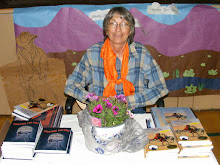
In a small town like Winnemucca, where you often run into people you know, it's a good idea for an author to have a large purse and always carry at least one book at all times. I've sold books standing in line at the post office and grocery store, to the bank teller, in parking lots, in Walmart, and half a dozen at the Ranch Hand Rodeo, where a boy I know saw me in the food line and said he had just finished my second book and LOVED IT, and the boy with him told me he couldn't wait to read it too. Great publicity, LOL.
Whether talking to a class I'm subbing in, or visiting with adults, I've found that many have misconceptions about writers. Some assume that publishing a book means the money just starts rolling in. Many are surprised to learn that an author must give a 40% discount to stores! This makes for a good class discussion on economics. They ask how much it cost me to publish my book, not realizing that it costs the author nothing in advance to go through a traditional publisher. Many ask why I didn't self-publish, so I explain that I thought seriously about it, and almost went that route when my efforts to find a publisher came to a standstill. It is becoming a more and more popular option, but there are pitfalls to that path, besides the initial cost to the author. I enjoy the opportunities to talk to people about writing and publishing.
Showing posts with label boy readers. Show all posts
Showing posts with label boy readers. Show all posts
Monday, March 3, 2014

Tuesday, October 20, 2009
In getting back into the sequel which I started years ago, I have used several writing strategies. First I reread, edited, cut and changed much of what I had. I looked at the pacing and decided my chapters were too long. I hope to attract reluctant boy readers, and my school experience the last few years convinced me that shorter chapters would make the book easier to handle. I cut almost every chapter in the middle, which meant I had to rethink the beginnings and endings of each chapter. I also divided the rest of my synopsis up into chapters, now that I know about how much needs to happen in each chapter. A check of my word count and a comparison to TOS showed me that I may be close to 2/3 done. It's time to start picking up the pace of the story. I made a timeline of events and chapters so I know what day I want the story to end on and what will take place on each of the last few days.
Next, I realized that the plot needed a little more focus. I reread some plotting guidelines, which reminded me to ask myself: what does the main character need or want, and what is standing in the way? What complications arise, so that it appears he will not be able to get what he wants? Thinking in these terms helped me to focus on what exactly Ben's fears and desires are, and what specific developments I could create to frustrate his desires, which increases suspense. This type of planning helped me to come up with ideas. And once I knew where I needed the story to go, I was able to go back to what I had already written and throw in a little foreshadowing--hints or shadows of what is to come.
The third strategy I used was to go back through my writer's notebook, which I hadn't looked at since I was finishing TOS. My notebook is full of cowboy sayings, cowboy stories, and other sayings and stories that I have collected, mostly from my husband and two sons. When I saw something that "grabbed" me, I would spend some time trying to figure out how I could weave that into the story. This would even give me ideas for adding to the plot or adding to scenes I had already written. Adding elements from real incidents gives more depth, detail, believability, and humor--"true fiction." As I wrote in an earlier post, writing is often like working a giant puzzle. Sometimes it's frustrating when you get stuck; then you find one little piece you need, and suddenly other little pieces start to jump out at you and fit together.
Next, I realized that the plot needed a little more focus. I reread some plotting guidelines, which reminded me to ask myself: what does the main character need or want, and what is standing in the way? What complications arise, so that it appears he will not be able to get what he wants? Thinking in these terms helped me to focus on what exactly Ben's fears and desires are, and what specific developments I could create to frustrate his desires, which increases suspense. This type of planning helped me to come up with ideas. And once I knew where I needed the story to go, I was able to go back to what I had already written and throw in a little foreshadowing--hints or shadows of what is to come.
The third strategy I used was to go back through my writer's notebook, which I hadn't looked at since I was finishing TOS. My notebook is full of cowboy sayings, cowboy stories, and other sayings and stories that I have collected, mostly from my husband and two sons. When I saw something that "grabbed" me, I would spend some time trying to figure out how I could weave that into the story. This would even give me ideas for adding to the plot or adding to scenes I had already written. Adding elements from real incidents gives more depth, detail, believability, and humor--"true fiction." As I wrote in an earlier post, writing is often like working a giant puzzle. Sometimes it's frustrating when you get stuck; then you find one little piece you need, and suddenly other little pieces start to jump out at you and fit together.
Subscribe to:
Posts (Atom)