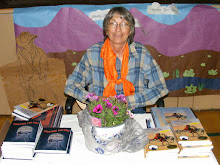
YEE-HAW!
Yep, I finished the sequel today! I've been so excited the last week or two, knowing how close I was, but I kept getting subbing jobs every day. I knew if I could just get a couple days to myself, I could do it. I couldn't write the last little bit in the evenings because I needed a quiet empty house to concentrate and "hear" what my characters were saying and thinking.
I've been thinking lately how funny it is that even though I know the plot and how my story will end, I don't know the details until I write them. And I don't write them until I put my characters in a situation, then watch them and listen to them--then I write it down. First you create believable characters, then you get to know them, then you put them in situations and see what happens. Sometimes they come up with the darned-est things. And sometimes I have to egg them on a little to get them going.
As I read my Bible, I see parallels to how God works. As a writer, I'm kind of playing "God." He's got a Big Plan (the plot) and various themes and sub-themes, which will work out the way He has planned, but within that plan, He gives us free will. And everything we choose ends up fitting into His Big Plan! (Unlike me, God doesn't have to wait to find out what His characters will choose to do--He already knows that, as well as the ending.)
Another thing I've been thinking about that relates to writing is working puzzles. I recently got some new bigger puzzles for my grandkids, and worked a few with them. I have always loved jigsaw puzzles, as well as crossword puzzles. I think perhaps working puzzles trains the brain to think in ways that help a writer: to look for and find seemingly unrelated things that might fit together, to foreshadow, to patiently work a little here and a little there on various themes and plot lines that will eventually converge.
So what do you think I'll do, now that I got to the end today? Do you think I'll kick back and take a break from writing? Give myself a party? Send it right off to a publisher? Start a new story? Guess again...every school kid should know the answer:
Rewrite! Edit! Polish! I'll go back to the beginning and read through (preferably out loud), looking for ways I can change passive voice to active voice. Looking for dull, overworked words that can be replaced with more interesting, active, descriptive words. Looking for awkward, wordy sentences that can be reworded or pared down. I do a little of this while writing, and while doing what rereading I've done. But if I see something I'm not satisfied with and can't think of a quick improvement, I don't let myself get bogged down there when I'd rather spend my limited time getting the whole story finished. I often just "bold" a word or sentence I want to rework so I can easily spot it later.
A writer needs to be able to separate her roles as creator and critic. Both roles are necessary, but should operate separately. First you create, then you critique your work. I do have a few people who are interested in reading and critiquing this story, providing some outside feedback. In the past I've been in critique groups, so I relied on others to point out what could be improved. I don't have one now, but hopefully I have learned enough from past groups, and from my experience working with the editor and publisher of The Orange Slipknot, that I can see my own work more objectively now and make improvements.
Showing posts with label characters. Show all posts
Showing posts with label characters. Show all posts
Wednesday, May 12, 2010

Tuesday, October 20, 2009
In getting back into the sequel which I started years ago, I have used several writing strategies. First I reread, edited, cut and changed much of what I had. I looked at the pacing and decided my chapters were too long. I hope to attract reluctant boy readers, and my school experience the last few years convinced me that shorter chapters would make the book easier to handle. I cut almost every chapter in the middle, which meant I had to rethink the beginnings and endings of each chapter. I also divided the rest of my synopsis up into chapters, now that I know about how much needs to happen in each chapter. A check of my word count and a comparison to TOS showed me that I may be close to 2/3 done. It's time to start picking up the pace of the story. I made a timeline of events and chapters so I know what day I want the story to end on and what will take place on each of the last few days.
Next, I realized that the plot needed a little more focus. I reread some plotting guidelines, which reminded me to ask myself: what does the main character need or want, and what is standing in the way? What complications arise, so that it appears he will not be able to get what he wants? Thinking in these terms helped me to focus on what exactly Ben's fears and desires are, and what specific developments I could create to frustrate his desires, which increases suspense. This type of planning helped me to come up with ideas. And once I knew where I needed the story to go, I was able to go back to what I had already written and throw in a little foreshadowing--hints or shadows of what is to come.
The third strategy I used was to go back through my writer's notebook, which I hadn't looked at since I was finishing TOS. My notebook is full of cowboy sayings, cowboy stories, and other sayings and stories that I have collected, mostly from my husband and two sons. When I saw something that "grabbed" me, I would spend some time trying to figure out how I could weave that into the story. This would even give me ideas for adding to the plot or adding to scenes I had already written. Adding elements from real incidents gives more depth, detail, believability, and humor--"true fiction." As I wrote in an earlier post, writing is often like working a giant puzzle. Sometimes it's frustrating when you get stuck; then you find one little piece you need, and suddenly other little pieces start to jump out at you and fit together.
Next, I realized that the plot needed a little more focus. I reread some plotting guidelines, which reminded me to ask myself: what does the main character need or want, and what is standing in the way? What complications arise, so that it appears he will not be able to get what he wants? Thinking in these terms helped me to focus on what exactly Ben's fears and desires are, and what specific developments I could create to frustrate his desires, which increases suspense. This type of planning helped me to come up with ideas. And once I knew where I needed the story to go, I was able to go back to what I had already written and throw in a little foreshadowing--hints or shadows of what is to come.
The third strategy I used was to go back through my writer's notebook, which I hadn't looked at since I was finishing TOS. My notebook is full of cowboy sayings, cowboy stories, and other sayings and stories that I have collected, mostly from my husband and two sons. When I saw something that "grabbed" me, I would spend some time trying to figure out how I could weave that into the story. This would even give me ideas for adding to the plot or adding to scenes I had already written. Adding elements from real incidents gives more depth, detail, believability, and humor--"true fiction." As I wrote in an earlier post, writing is often like working a giant puzzle. Sometimes it's frustrating when you get stuck; then you find one little piece you need, and suddenly other little pieces start to jump out at you and fit together.
Monday, January 28, 2008
The next big push after getting out numerous press releases was to get copies of the book placed in Elko, Nevada before the big Cowboy Poetry Gathering this last week in January. I spent over a week making phone calls and emailing stores and libraries, then decided to just take a half-day and make the two-hour drive so I could make deliveries and hopefully sew up a few locations by a personal contact. This was my husband's first exposure to making book sales; I think we were both taken aback by the enthusiastic response of those I talked to. Of course, the book's Elko setting and buckaroo theme makes it a natural choice in northern Nevada. I left almost 60 books in Elko, and a third that many in Battle Mountain.
Now I can back off the heavy-duty selling a bit and have a more regular life again while the books find their way into the hands of the public. I notified the Institute of Children's Literature that one of their graduates had sold her first book, so they wrote back, requesting details. I also started putting together photos for a slide show for possible presentations--finding and selecting old pictures, scanning them onto the computer, fixing them up in Adobe Photoshop, organizing them, teaching myself how to put them into Microsoft Powerpoint which I know nothing about, and planning the talk that would accompany them. These two projects took me back through 10-15 years of memories as I retraced the steps that led to publication of my book.
And yes, I have been working on the sequel. Just as with The Orange Slipknot, much of my "writing" involves mulling over possibilities for character and plot development, so much of what I call "writing time" has nothing to do with actually adding more words to the story. I "write" while getting ready for work, while spending a half-hour every morning at crosswalk duty, while cooking, eating, cleaning house, or driving. I even work on my story when I'm awake in the night and can't get back to sleep.
Now I can back off the heavy-duty selling a bit and have a more regular life again while the books find their way into the hands of the public. I notified the Institute of Children's Literature that one of their graduates had sold her first book, so they wrote back, requesting details. I also started putting together photos for a slide show for possible presentations--finding and selecting old pictures, scanning them onto the computer, fixing them up in Adobe Photoshop, organizing them, teaching myself how to put them into Microsoft Powerpoint which I know nothing about, and planning the talk that would accompany them. These two projects took me back through 10-15 years of memories as I retraced the steps that led to publication of my book.
And yes, I have been working on the sequel. Just as with The Orange Slipknot, much of my "writing" involves mulling over possibilities for character and plot development, so much of what I call "writing time" has nothing to do with actually adding more words to the story. I "write" while getting ready for work, while spending a half-hour every morning at crosswalk duty, while cooking, eating, cleaning house, or driving. I even work on my story when I'm awake in the night and can't get back to sleep.
Subscribe to:
Posts (Atom)