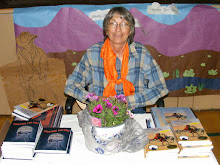
During a recent subbing job, while assigning an article on environmentalism, I was reminded of one of several reasons I am writing books.
When our boys were little (if you know them, you'll find it hard to believe they were ever little!), my husband and I moved to northern Nevada--ranching country. I was fascinated with ranch and cowboy life, so different from my more urban background. I realized many kids have no idea where their food comes from or the importance agriculture plays in our lives. Food doesn't come from the store--it is produced by farmers and ranchers. Cowboys aren't just colorful characters in the Old West, movies, or rodeos, but play in important role in beef production.
Having been a bookworm all my life, I read piles of books to my little ones, hoping to instill in them the love of books. Many were engaging and well-written, but some made me wonder if I couldn't have written a better one myself! I began to toy with the thought of someday writing books for children.
Fast forward a few years. My boys are bringing home papers from school with a strong environmentalist slant, sometimes (as in the assignment I mentioned above) with a blatant anti-farming/ranching element. My pro-agriculture feelings were kindled even further.
By this time I was writing and selling stories and articles to magazines and felt ready to attempt a book. I had read that nonfiction was a good way for a new author to break into the publishing game. I fumbled around with a few fruitless endeavors before it occurred to me that I could probably appeal to more kids in a fiction format, weaving background information into my story.
Not only did this approach prove successful, but during author talks I can bring out the agriculture angle even more, as part of an entertaining slideshow. The curriculum unit, while primarily integrating elements of reading and writing, helps teachers use the agriculture focus as a science connection and the Nevada ranching focus as a social studies connection.
Unfortunately, there was no time the other day to take the time to talk with my class about environmentalism, its agenda, and how it is pushed in the classroom and elsewhere. But through my books, I am doing what I can to educate kids about agriculture and the unique ranching sub-culture of the West.
Showing posts with label Nevada. Show all posts
Showing posts with label Nevada. Show all posts
Saturday, March 12, 2016

Sunday, February 2, 2014
Well, it has actually happened--my second book, Starting the Colt, is out! It even arrived earlier than expected from the printer. Now it's time to take off my writer's hat and put on my marketer's hat--not my favorite hat. I'd much rather be spending more time with my cowboy hat, but that's not going to happen for awhile, what with winter cold and snow. So it's a good time of year to be selling books in my spare time.
I am an introvert--I don't enjoy publicity or the process of publicizing my books, but I am trying to balance the side of me that would prefer to remain invisible. Every time I take a load of books to the post office, the rewards of marketing outweigh the challenges. Starting the Colt is now at the library and available in over half a dozen stores across northern Nevada. I just barely got it in at the Western Folklife Center in Elko before the week of the National Cowboy Poetry Gathering.
My hard-working publisher, Janet Muirhead Hill, at Raven Publishing, has Starting the Colt up on Amazon.com, both as a paperback and as a Kindle book. She has been so great to work with--promptly answering my many questions, always making good suggestions and guiding our projects in the right direction.
As I have been subbing, I have shared with students the progress of my book in its journey toward publication and had a few opportunities to give mini-author talks or short readings. I love talking to students about reading and writing.
Other projects include tweaking my website (www.janyoungauthor.com) and placing the curriculum unit that I wrote last summer on TeachersPayTeachers.com. I have spent the past month and a half familiarizing myself with TpT--the products, the descriptions, and the process of formatting and uploading a digital product. Here, teachers can easily access the CU for an affordable price, and even download a free introductory mini-unit. Visit my TpT store to find "STARTING THE COLT Curriculum Unit Common Core Aligned" and "STARTING THE COLT Mini-Curriculum Unit Common Core Aligned."
I am an introvert--I don't enjoy publicity or the process of publicizing my books, but I am trying to balance the side of me that would prefer to remain invisible. Every time I take a load of books to the post office, the rewards of marketing outweigh the challenges. Starting the Colt is now at the library and available in over half a dozen stores across northern Nevada. I just barely got it in at the Western Folklife Center in Elko before the week of the National Cowboy Poetry Gathering.
My hard-working publisher, Janet Muirhead Hill, at Raven Publishing, has Starting the Colt up on Amazon.com, both as a paperback and as a Kindle book. She has been so great to work with--promptly answering my many questions, always making good suggestions and guiding our projects in the right direction.
As I have been subbing, I have shared with students the progress of my book in its journey toward publication and had a few opportunities to give mini-author talks or short readings. I love talking to students about reading and writing.
Other projects include tweaking my website (www.janyoungauthor.com) and placing the curriculum unit that I wrote last summer on TeachersPayTeachers.com. I have spent the past month and a half familiarizing myself with TpT--the products, the descriptions, and the process of formatting and uploading a digital product. Here, teachers can easily access the CU for an affordable price, and even download a free introductory mini-unit. Visit my TpT store to find "STARTING THE COLT Curriculum Unit Common Core Aligned" and "STARTING THE COLT Mini-Curriculum Unit Common Core Aligned."
Wednesday, July 31, 2013
.
Some writing is hard work, but some is serendipity. Yesterday I started to create a curriculum unit activity for a science connection, then remembered that many years ago, I created something similar that is still in my old files. I pulled it out, spent the day revising it, and voila! Just what I needed!
One of the rules of writing is, "Write what you know and care about," so I started out years ago writing about Nevada, cowboying, and ag-related topics. Much of what I came up with in my early writing days never sold, but waited patiently for the right opportunity to jump out and find its niche. I love seeing how some of my original ideas, after aging a bit, found new angles and became part of The Orange Slipknot or Starting the Colt. As I recently read in Ecclesiastes 3:1, "there is an appointed time for everything."
One of the rules of writing is, "Write what you know and care about," so I started out years ago writing about Nevada, cowboying, and ag-related topics. Much of what I came up with in my early writing days never sold, but waited patiently for the right opportunity to jump out and find its niche. I love seeing how some of my original ideas, after aging a bit, found new angles and became part of The Orange Slipknot or Starting the Colt. As I recently read in Ecclesiastes 3:1, "there is an appointed time for everything."
Monday, January 28, 2008
The next big push after getting out numerous press releases was to get copies of the book placed in Elko, Nevada before the big Cowboy Poetry Gathering this last week in January. I spent over a week making phone calls and emailing stores and libraries, then decided to just take a half-day and make the two-hour drive so I could make deliveries and hopefully sew up a few locations by a personal contact. This was my husband's first exposure to making book sales; I think we were both taken aback by the enthusiastic response of those I talked to. Of course, the book's Elko setting and buckaroo theme makes it a natural choice in northern Nevada. I left almost 60 books in Elko, and a third that many in Battle Mountain.
Now I can back off the heavy-duty selling a bit and have a more regular life again while the books find their way into the hands of the public. I notified the Institute of Children's Literature that one of their graduates had sold her first book, so they wrote back, requesting details. I also started putting together photos for a slide show for possible presentations--finding and selecting old pictures, scanning them onto the computer, fixing them up in Adobe Photoshop, organizing them, teaching myself how to put them into Microsoft Powerpoint which I know nothing about, and planning the talk that would accompany them. These two projects took me back through 10-15 years of memories as I retraced the steps that led to publication of my book.
And yes, I have been working on the sequel. Just as with The Orange Slipknot, much of my "writing" involves mulling over possibilities for character and plot development, so much of what I call "writing time" has nothing to do with actually adding more words to the story. I "write" while getting ready for work, while spending a half-hour every morning at crosswalk duty, while cooking, eating, cleaning house, or driving. I even work on my story when I'm awake in the night and can't get back to sleep.
Now I can back off the heavy-duty selling a bit and have a more regular life again while the books find their way into the hands of the public. I notified the Institute of Children's Literature that one of their graduates had sold her first book, so they wrote back, requesting details. I also started putting together photos for a slide show for possible presentations--finding and selecting old pictures, scanning them onto the computer, fixing them up in Adobe Photoshop, organizing them, teaching myself how to put them into Microsoft Powerpoint which I know nothing about, and planning the talk that would accompany them. These two projects took me back through 10-15 years of memories as I retraced the steps that led to publication of my book.
And yes, I have been working on the sequel. Just as with The Orange Slipknot, much of my "writing" involves mulling over possibilities for character and plot development, so much of what I call "writing time" has nothing to do with actually adding more words to the story. I "write" while getting ready for work, while spending a half-hour every morning at crosswalk duty, while cooking, eating, cleaning house, or driving. I even work on my story when I'm awake in the night and can't get back to sleep.
Sunday, October 14, 2007
On August 18 I wrote some comments about how many Americans don't see the relationship between ranching and our food supply. I recently came across this quote in Range Magazine, from the article "Healing the Land with Livestock":
"About 98.5% of Americans are city or suburban based and have no connection with the production of the food they consume. Only 1.5% of the American population has anything to do with producing food."
This is one of my motivations for writing about ranching and Nevada. Our nation's roots are in agriculture, but in the last several generations, most lifestyles have become distant from farming or ranching. Food comes from the grocery store, not outside the back door.
I grew up in the suburbs of Sacramento, California. When I first met my husband, I remember asking him what was in that little building behind his barn. He said that was his pumphouse. I said, "You have your own WELL?" He laughed and asked where I thought water came from? I said, "From pipes under the street!" That really made him laugh! I had a college education and I knew that water came from underground, but I had never known anyone who actually had a well. Everyone had "city water" and got a water bill from the city. I was surprised to learn that people with wells don't get water bills; electric pumps pump the water to their homes, so instead of a water bill, they just have a bigger electricity bill.
Because few families raise animals for food, few kids see animals killed to provide their meat. At the same time this trend was developing, kids began watching cartoons with cute talking animals. The thought of killing "cute" animals and eating them horrifies many kids. Farm and ranch kids see, accept and understand this fact of life. Many city kids grow up with an unrealistic view of our food supply, then fall prey to the propaganda of the environmentalists who paint ranchers as enemies of the land. I hope that as I show city kids the ranching lifestyle in a fictional setting, they will come to understand not only our American agricultural heritage, but the need for ranching today.
As far as the progress of The Orange Slipknot, I finally finished the curriculum unit. I am so excited about the thought of classrooms full of kids reading this book and learning about Nevada, ranching, and cowboys! The curriculum unit provides teachers with many questions, activities and writing assignments. It was also very exciting to contact all my friends and announce that the book is now on sale! Many people are already placing their orders.
"About 98.5% of Americans are city or suburban based and have no connection with the production of the food they consume. Only 1.5% of the American population has anything to do with producing food."
This is one of my motivations for writing about ranching and Nevada. Our nation's roots are in agriculture, but in the last several generations, most lifestyles have become distant from farming or ranching. Food comes from the grocery store, not outside the back door.
I grew up in the suburbs of Sacramento, California. When I first met my husband, I remember asking him what was in that little building behind his barn. He said that was his pumphouse. I said, "You have your own WELL?" He laughed and asked where I thought water came from? I said, "From pipes under the street!" That really made him laugh! I had a college education and I knew that water came from underground, but I had never known anyone who actually had a well. Everyone had "city water" and got a water bill from the city. I was surprised to learn that people with wells don't get water bills; electric pumps pump the water to their homes, so instead of a water bill, they just have a bigger electricity bill.
Because few families raise animals for food, few kids see animals killed to provide their meat. At the same time this trend was developing, kids began watching cartoons with cute talking animals. The thought of killing "cute" animals and eating them horrifies many kids. Farm and ranch kids see, accept and understand this fact of life. Many city kids grow up with an unrealistic view of our food supply, then fall prey to the propaganda of the environmentalists who paint ranchers as enemies of the land. I hope that as I show city kids the ranching lifestyle in a fictional setting, they will come to understand not only our American agricultural heritage, but the need for ranching today.
As far as the progress of The Orange Slipknot, I finally finished the curriculum unit. I am so excited about the thought of classrooms full of kids reading this book and learning about Nevada, ranching, and cowboys! The curriculum unit provides teachers with many questions, activities and writing assignments. It was also very exciting to contact all my friends and announce that the book is now on sale! Many people are already placing their orders.
Saturday, August 18, 2007
Lately I have been working on the Nevada pages of the curriculum unit. I wrote The Orange Slipknot because I wanted to share my love of Nevada--not the glitz of Las Vegas, but the beauty and uniqueness of buckaroo country. I grew up in California, so Nevada is my adopted state. I was a town girl, not a country girl. I never imagined I would grow up to marry a cowboy and raise my kids 50 miles from a town. Life here was so different from what I had known. My letters home to family and friends were filled with adventures and anecdotes that had them shaking their heads. More than once I was told I should write a book. Those letters contained the seeds of stories to come.
When I started my journey into writing, I began by reading books about writing for children. They all advised, "Write about what you know and feel passionately about." I knew I would write about kids growing up in Nevada. My first piece of writing was called "The Best Thing About Nevada," in which a boy tells about all the things he loves about living in Nevada and cowboying with his dad. I didn't know it then, but it was "Ben" in disguise! So many elements from that essay found their way into The Orange Slipknot years later.
Not too long after that I took a course on writing for children. Several of my assignments became Nevada pieces of one sort or another. The first piece that I sold was a magazine article about kids and horses. It would be a few years before I came up with a story that I thought I could develop into a book, but this book was destined to be about growing up in Nevada's cowboy country.
Cowboy country is ranching country, and ranching means beef cattle. As I got more and more interested in sharing my ideas with kids unfamiliar with this lifestyle, I began to realize that many kids don't even know where hamburger comes from. I got involved with Ag in the Classroom and started reading Range magazine. I began to think about how I could use stories to help educate kids about agriculture while entertaining them with cowboy tales.
Agricultural roots were once strong in this country, but now most people are so far from that lifestyle that they have little concept of the relationship between ranching and our food supply. Much of what people do hear about ranching is filtered through the environmentalist view that ranching on public lands is evil and that ranchers are rich free-loaders. Many people probably associate cowboys with either the past or with rodeos, not realizing that this lifestyle is still alive and well in the contemporary West.
I was fairly sure that few juvenile publishers were interested in my topic, preferring urban and multi-cultural settings. When I found Raven Publishing's website and read that the publisher was from a ranching background, my hopes rose. Finally I found a publisher who shared my values!
When I started my journey into writing, I began by reading books about writing for children. They all advised, "Write about what you know and feel passionately about." I knew I would write about kids growing up in Nevada. My first piece of writing was called "The Best Thing About Nevada," in which a boy tells about all the things he loves about living in Nevada and cowboying with his dad. I didn't know it then, but it was "Ben" in disguise! So many elements from that essay found their way into The Orange Slipknot years later.
Not too long after that I took a course on writing for children. Several of my assignments became Nevada pieces of one sort or another. The first piece that I sold was a magazine article about kids and horses. It would be a few years before I came up with a story that I thought I could develop into a book, but this book was destined to be about growing up in Nevada's cowboy country.
Cowboy country is ranching country, and ranching means beef cattle. As I got more and more interested in sharing my ideas with kids unfamiliar with this lifestyle, I began to realize that many kids don't even know where hamburger comes from. I got involved with Ag in the Classroom and started reading Range magazine. I began to think about how I could use stories to help educate kids about agriculture while entertaining them with cowboy tales.
Agricultural roots were once strong in this country, but now most people are so far from that lifestyle that they have little concept of the relationship between ranching and our food supply. Much of what people do hear about ranching is filtered through the environmentalist view that ranching on public lands is evil and that ranchers are rich free-loaders. Many people probably associate cowboys with either the past or with rodeos, not realizing that this lifestyle is still alive and well in the contemporary West.
I was fairly sure that few juvenile publishers were interested in my topic, preferring urban and multi-cultural settings. When I found Raven Publishing's website and read that the publisher was from a ranching background, my hopes rose. Finally I found a publisher who shared my values!
Subscribe to:
Posts (Atom)