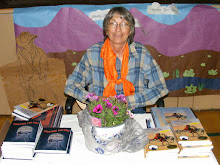
In getting back into the sequel which I started years ago, I have used several writing strategies. First I reread, edited, cut and changed much of what I had. I looked at the pacing and decided my chapters were too long. I hope to attract reluctant boy readers, and my school experience the last few years convinced me that shorter chapters would make the book easier to handle. I cut almost every chapter in the middle, which meant I had to rethink the beginnings and endings of each chapter. I also divided the rest of my synopsis up into chapters, now that I know about how much needs to happen in each chapter. A check of my word count and a comparison to TOS showed me that I may be close to 2/3 done. It's time to start picking up the pace of the story. I made a timeline of events and chapters so I know what day I want the story to end on and what will take place on each of the last few days.
Next, I realized that the plot needed a little more focus. I reread some plotting guidelines, which reminded me to ask myself: what does the main character need or want, and what is standing in the way? What complications arise, so that it appears he will not be able to get what he wants? Thinking in these terms helped me to focus on what exactly Ben's fears and desires are, and what specific developments I could create to frustrate his desires, which increases suspense. This type of planning helped me to come up with ideas. And once I knew where I needed the story to go, I was able to go back to what I had already written and throw in a little foreshadowing--hints or shadows of what is to come.
The third strategy I used was to go back through my writer's notebook, which I hadn't looked at since I was finishing TOS. My notebook is full of cowboy sayings, cowboy stories, and other sayings and stories that I have collected, mostly from my husband and two sons. When I saw something that "grabbed" me, I would spend some time trying to figure out how I could weave that into the story. This would even give me ideas for adding to the plot or adding to scenes I had already written. Adding elements from real incidents gives more depth, detail, believability, and humor--"true fiction." As I wrote in an earlier post, writing is often like working a giant puzzle. Sometimes it's frustrating when you get stuck; then you find one little piece you need, and suddenly other little pieces start to jump out at you and fit together.
Showing posts with label suspense. Show all posts
Showing posts with label suspense. Show all posts
Tuesday, October 20, 2009

Saturday, October 11, 2008
I just finished reading a novel by a major American novelist and found it quite boring. There was no opening hook to grab my interest; I kept hoping that on the next page, a gripping plot would suddenly develop, but it never did. I slogged through the book by sheer determination. There was little action, little suspense, long unbroken passages of dialogue, and I found myself skimming over much of the book, just trying to get it over with. The only reason I continued to read was my interest in the subject matter of the book.
Many aspects of this book did not match up with what I had been taught about basics. Because of the author’s reputation, and my contrasting lack of knowledge and experience, I wondered if the problem was somehow me. I thought, who am I to question the technique of a popular established author? Am I off-base here? Perhaps I lacked appreciation for what others thought was actually a good book. I knew how to find out what others thought: I went to Amazon.com, did a search for this book, and read all the reader reviews.
I was relieved to find that most readers’ opinions were similar to mine. I gained confidence in my ability to critique the writing of others. I realized that just because an author is talented, not every piece of his or her writing is guaranteed to be equally good. Each piece must stand or fall on its own merits.
I have just started on another of his books--again, because of my interest in the subject matter, and because it comes recommended by someone else. I’m half way through the first chapter and am still waiting for it to “grab” me. I doubt I'll read this book. I have always loved books and am willing to give the author many chances to hook me, but other readers may not be so forgiving. I think a weakness of many books is to start by laying the foundation for the story, instead of jumping right into the action, filling in the details and background as it goes along.
As a writer of books for children, I know that I am competing with TV and computers. I only have a page or two in which to hook a reluctant reader, and each chapter must leave the reader wanting to know more. There must be action, dialogue, little narration, and opportunities to “hear” what the protagonist is thinking, so that the reader almost “becomes” the protagonist--seeing what he sees, hearing what he hears, feeling what he feels. This is what I work towards.
Many aspects of this book did not match up with what I had been taught about basics. Because of the author’s reputation, and my contrasting lack of knowledge and experience, I wondered if the problem was somehow me. I thought, who am I to question the technique of a popular established author? Am I off-base here? Perhaps I lacked appreciation for what others thought was actually a good book. I knew how to find out what others thought: I went to Amazon.com, did a search for this book, and read all the reader reviews.
I was relieved to find that most readers’ opinions were similar to mine. I gained confidence in my ability to critique the writing of others. I realized that just because an author is talented, not every piece of his or her writing is guaranteed to be equally good. Each piece must stand or fall on its own merits.
I have just started on another of his books--again, because of my interest in the subject matter, and because it comes recommended by someone else. I’m half way through the first chapter and am still waiting for it to “grab” me. I doubt I'll read this book. I have always loved books and am willing to give the author many chances to hook me, but other readers may not be so forgiving. I think a weakness of many books is to start by laying the foundation for the story, instead of jumping right into the action, filling in the details and background as it goes along.
As a writer of books for children, I know that I am competing with TV and computers. I only have a page or two in which to hook a reluctant reader, and each chapter must leave the reader wanting to know more. There must be action, dialogue, little narration, and opportunities to “hear” what the protagonist is thinking, so that the reader almost “becomes” the protagonist--seeing what he sees, hearing what he hears, feeling what he feels. This is what I work towards.
Subscribe to:
Posts (Atom)