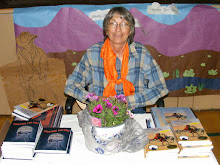
YEE-HAW!
Yep, I finished the sequel today! I've been so excited the last week or two, knowing how close I was, but I kept getting subbing jobs every day. I knew if I could just get a couple days to myself, I could do it. I couldn't write the last little bit in the evenings because I needed a quiet empty house to concentrate and "hear" what my characters were saying and thinking.
I've been thinking lately how funny it is that even though I know the plot and how my story will end, I don't know the details until I write them. And I don't write them until I put my characters in a situation, then watch them and listen to them--then I write it down. First you create believable characters, then you get to know them, then you put them in situations and see what happens. Sometimes they come up with the darned-est things. And sometimes I have to egg them on a little to get them going.
As I read my Bible, I see parallels to how God works. As a writer, I'm kind of playing "God." He's got a Big Plan (the plot) and various themes and sub-themes, which will work out the way He has planned, but within that plan, He gives us free will. And everything we choose ends up fitting into His Big Plan! (Unlike me, God doesn't have to wait to find out what His characters will choose to do--He already knows that, as well as the ending.)
Another thing I've been thinking about that relates to writing is working puzzles. I recently got some new bigger puzzles for my grandkids, and worked a few with them. I have always loved jigsaw puzzles, as well as crossword puzzles. I think perhaps working puzzles trains the brain to think in ways that help a writer: to look for and find seemingly unrelated things that might fit together, to foreshadow, to patiently work a little here and a little there on various themes and plot lines that will eventually converge.
So what do you think I'll do, now that I got to the end today? Do you think I'll kick back and take a break from writing? Give myself a party? Send it right off to a publisher? Start a new story? Guess again...every school kid should know the answer:
Rewrite! Edit! Polish! I'll go back to the beginning and read through (preferably out loud), looking for ways I can change passive voice to active voice. Looking for dull, overworked words that can be replaced with more interesting, active, descriptive words. Looking for awkward, wordy sentences that can be reworded or pared down. I do a little of this while writing, and while doing what rereading I've done. But if I see something I'm not satisfied with and can't think of a quick improvement, I don't let myself get bogged down there when I'd rather spend my limited time getting the whole story finished. I often just "bold" a word or sentence I want to rework so I can easily spot it later.
A writer needs to be able to separate her roles as creator and critic. Both roles are necessary, but should operate separately. First you create, then you critique your work. I do have a few people who are interested in reading and critiquing this story, providing some outside feedback. In the past I've been in critique groups, so I relied on others to point out what could be improved. I don't have one now, but hopefully I have learned enough from past groups, and from my experience working with the editor and publisher of The Orange Slipknot, that I can see my own work more objectively now and make improvements.
Wednesday, May 12, 2010

Tuesday, March 30, 2010
Just when I really had some good momentum going, a series of bumps, curves and distractions got in the way. When I've got too much going on, writing is not my priority. So I'm confessing that, unfortunately, I've written very little since the first of the year.
Fortunately, I had some opportunities to market and sell books and do a couple presentations. I had a display table at a local event for Martin Luther King Jr. Day. I almost backed out of my presentation on Nevada's ranching history at the Nevada Reading Week Conference in Reno; I had been down for 4 days with a fever, but fortunately it broke the night before--thank goodness for Advil.
Now to overcome inertia and get that momentum going again. I've slowly been getting back into writing the last couple weeks. The better I feel, the more I feel like writing. Still coughing but back to work...everyone's telling me this may hang on for weeks yet...
Fortunately, I had some opportunities to market and sell books and do a couple presentations. I had a display table at a local event for Martin Luther King Jr. Day. I almost backed out of my presentation on Nevada's ranching history at the Nevada Reading Week Conference in Reno; I had been down for 4 days with a fever, but fortunately it broke the night before--thank goodness for Advil.
Now to overcome inertia and get that momentum going again. I've slowly been getting back into writing the last couple weeks. The better I feel, the more I feel like writing. Still coughing but back to work...everyone's telling me this may hang on for weeks yet...
Sunday, December 13, 2009
Something exciting has been happening the last couple months--I have learned a new way to write! And it's been working great! No one told me to try this; I didn't read it anywhere (that I can remember, anyway). I just kind of stumbled into it.
I wrote The Orange Slipknot straight through. When I got stuck, I stopped and thought until I figured out what would come next. I had lots of time on my hands in those days--chunks of several hours of unbroken quiet time, several times a week, to think and write. One of my frustrations with writing the sequel has been that my life is busier now, and it's hard to write in short chunks of quiet time here and there, or when my husband is home and the TV is on.
One evening I was sitting in the recliner with my laptop (where I usually write), staring at my synopsis, distracted by the TV. Because I couldn't write, I decided I'd just add a couple of thoughts to my synopsis. That wasn't so hard...so I added a little more. I kept staring absently at my screen, not really thinking about trying to write--half listening to the TV.
I noticed that one section of my synopsis was getting pretty detailed. It was about a conversation between Ben and his dad. It occurred to me that perhaps I could just edit that section a little and turn it into actual conversation. I added quotation marks, paragraphing, changed the wording a little, and suddenly, I had half a page of finished dialogue! Wow--I laughed out loud!
It didn't fit where I had left off in the story. It didn't even fit in that chapter--it was "future." But that was okay--it was a chunk of good writing that was ready and waiting for when the story arrived at that point. I wondered if I could do that again, somewhere else in my synopsis. I began playing with the synopsis, every time I sat down to write--adding ideas and details, then turning some little part of it into a few finished paragraphs.
One day I realized I had enough finished chunks to make a chapter! I just had to sketch in a few transitions, a chapter opening and ending, then a little editing to smooth it all out. I couldn't believe I had created a chapter like that--I had never done anything like that before. I had written it all backwards, but it worked! I didn't know yet how I would connect this to what I already had, but I could go back later and work on that. Meanwhile, I would work on little sections that "grabbed me."
I'm not an artist, but perhaps it is like painting a picture. You don't just start at the top and work your way down. You might start by sketching out some outlines and some ideas for colors. Maybe you work on one part, then a bit of another part, then maybe even get some details on one particular part. Then you might step back and look at it, making sure it's all going to balance out before you get too involved in one particular part. Here and there, you fill in, round out.
When I realized that I didn't have to write "in a straight line," a big burden lifted. Instead of staring unproductively at the place I was stuck, I could skip ahead and "play" with my synopsis. I am getting very excited about finishing this book!
I have written almost four chapters in the last two months using this method. I'm on the home stretch--the final fourth of the book--and I've had several new ideas that add to the plot. One came to me while watching the news. Another, when my husband happened to use the word "snudge," leading to an interesting conversation. One character that originally had a minor part in the story has developed more of a presence than I originally foresaw, adding a nice sub-plot and sub-theme. Several other possible ideas seem to be headed for the virtual trash can. I have one more tricky place to work on, then it's pretty well lined out.
I wrote The Orange Slipknot straight through. When I got stuck, I stopped and thought until I figured out what would come next. I had lots of time on my hands in those days--chunks of several hours of unbroken quiet time, several times a week, to think and write. One of my frustrations with writing the sequel has been that my life is busier now, and it's hard to write in short chunks of quiet time here and there, or when my husband is home and the TV is on.
One evening I was sitting in the recliner with my laptop (where I usually write), staring at my synopsis, distracted by the TV. Because I couldn't write, I decided I'd just add a couple of thoughts to my synopsis. That wasn't so hard...so I added a little more. I kept staring absently at my screen, not really thinking about trying to write--half listening to the TV.
I noticed that one section of my synopsis was getting pretty detailed. It was about a conversation between Ben and his dad. It occurred to me that perhaps I could just edit that section a little and turn it into actual conversation. I added quotation marks, paragraphing, changed the wording a little, and suddenly, I had half a page of finished dialogue! Wow--I laughed out loud!
It didn't fit where I had left off in the story. It didn't even fit in that chapter--it was "future." But that was okay--it was a chunk of good writing that was ready and waiting for when the story arrived at that point. I wondered if I could do that again, somewhere else in my synopsis. I began playing with the synopsis, every time I sat down to write--adding ideas and details, then turning some little part of it into a few finished paragraphs.
One day I realized I had enough finished chunks to make a chapter! I just had to sketch in a few transitions, a chapter opening and ending, then a little editing to smooth it all out. I couldn't believe I had created a chapter like that--I had never done anything like that before. I had written it all backwards, but it worked! I didn't know yet how I would connect this to what I already had, but I could go back later and work on that. Meanwhile, I would work on little sections that "grabbed me."
I'm not an artist, but perhaps it is like painting a picture. You don't just start at the top and work your way down. You might start by sketching out some outlines and some ideas for colors. Maybe you work on one part, then a bit of another part, then maybe even get some details on one particular part. Then you might step back and look at it, making sure it's all going to balance out before you get too involved in one particular part. Here and there, you fill in, round out.
When I realized that I didn't have to write "in a straight line," a big burden lifted. Instead of staring unproductively at the place I was stuck, I could skip ahead and "play" with my synopsis. I am getting very excited about finishing this book!
I have written almost four chapters in the last two months using this method. I'm on the home stretch--the final fourth of the book--and I've had several new ideas that add to the plot. One came to me while watching the news. Another, when my husband happened to use the word "snudge," leading to an interesting conversation. One character that originally had a minor part in the story has developed more of a presence than I originally foresaw, adding a nice sub-plot and sub-theme. Several other possible ideas seem to be headed for the virtual trash can. I have one more tricky place to work on, then it's pretty well lined out.
Tuesday, October 20, 2009
In getting back into the sequel which I started years ago, I have used several writing strategies. First I reread, edited, cut and changed much of what I had. I looked at the pacing and decided my chapters were too long. I hope to attract reluctant boy readers, and my school experience the last few years convinced me that shorter chapters would make the book easier to handle. I cut almost every chapter in the middle, which meant I had to rethink the beginnings and endings of each chapter. I also divided the rest of my synopsis up into chapters, now that I know about how much needs to happen in each chapter. A check of my word count and a comparison to TOS showed me that I may be close to 2/3 done. It's time to start picking up the pace of the story. I made a timeline of events and chapters so I know what day I want the story to end on and what will take place on each of the last few days.
Next, I realized that the plot needed a little more focus. I reread some plotting guidelines, which reminded me to ask myself: what does the main character need or want, and what is standing in the way? What complications arise, so that it appears he will not be able to get what he wants? Thinking in these terms helped me to focus on what exactly Ben's fears and desires are, and what specific developments I could create to frustrate his desires, which increases suspense. This type of planning helped me to come up with ideas. And once I knew where I needed the story to go, I was able to go back to what I had already written and throw in a little foreshadowing--hints or shadows of what is to come.
The third strategy I used was to go back through my writer's notebook, which I hadn't looked at since I was finishing TOS. My notebook is full of cowboy sayings, cowboy stories, and other sayings and stories that I have collected, mostly from my husband and two sons. When I saw something that "grabbed" me, I would spend some time trying to figure out how I could weave that into the story. This would even give me ideas for adding to the plot or adding to scenes I had already written. Adding elements from real incidents gives more depth, detail, believability, and humor--"true fiction." As I wrote in an earlier post, writing is often like working a giant puzzle. Sometimes it's frustrating when you get stuck; then you find one little piece you need, and suddenly other little pieces start to jump out at you and fit together.
Next, I realized that the plot needed a little more focus. I reread some plotting guidelines, which reminded me to ask myself: what does the main character need or want, and what is standing in the way? What complications arise, so that it appears he will not be able to get what he wants? Thinking in these terms helped me to focus on what exactly Ben's fears and desires are, and what specific developments I could create to frustrate his desires, which increases suspense. This type of planning helped me to come up with ideas. And once I knew where I needed the story to go, I was able to go back to what I had already written and throw in a little foreshadowing--hints or shadows of what is to come.
The third strategy I used was to go back through my writer's notebook, which I hadn't looked at since I was finishing TOS. My notebook is full of cowboy sayings, cowboy stories, and other sayings and stories that I have collected, mostly from my husband and two sons. When I saw something that "grabbed" me, I would spend some time trying to figure out how I could weave that into the story. This would even give me ideas for adding to the plot or adding to scenes I had already written. Adding elements from real incidents gives more depth, detail, believability, and humor--"true fiction." As I wrote in an earlier post, writing is often like working a giant puzzle. Sometimes it's frustrating when you get stuck; then you find one little piece you need, and suddenly other little pieces start to jump out at you and fit together.
Tuesday, October 6, 2009
Publishing a book is exciting stuff, but being a writer is not necessarily glamorous. Discouragement, writer's block, and heavy-duty rewriting are problems I have tackled recently, but things are looking up.
When people ask me when the next book is coming out, I hate admitting that I never worked on it all last school year. I justified my lack of writing by claiming lack of time--instead spending my limited "writing time" on the phone selling The Orange Slipknot. The problem may have been writer's block. Or it may have been plain old laziness and procrastination. I don't want to become a slave to either TOS or the sequel; I don't want them to run my life. Even when school was out, I didn't find time to write; my summer vacation seemed gone almost before it started, between a trip to Australia to do a horsemanship clinic, time to be grandma, riding horses, yard work, and the usual summer projects. But the good news is, I am finally back in the writing mode, and my goal is to finish the sequel this school year.
I started writing the sequel shortly after finishing TOS, about 12 years or so ago. When you finish a manuscript and begin the submission process, it's time to start working on a new project, which I did. I had an idea for a sequel sketched out in a brief synopsis, and managed to write about half the story. Then I got stuck, and, not having even sold the first book yet, I didn't have enough motivation to work through the problem. I put it aside and decided that if I ever sold the first book, THEN I'd return to working on the sequel. What ended up happening was, after about 20 rejection notices on TOS, I practically gave up on writing in general. In the next few years, I got busier job-wise so writing was on the back burner, so to speak. When I finally sold TOS, it was a real challenge to find time in my life for the editing process, and later, for marketing.
I did a little work on the sequel about two years ago, but had trouble getting back into writing on a regular basis. This year I've had a change of schedule; my job as Remediation Tutor has ended. It was grant-funded, and with the state budget shortage, the grant was no longer available. I am back to substitute teaching, which gives me a day off here and there. My plan is to use those non-work days as writing days, and so far, it's working out great. I prefer to write when I have big chunks of time alone, something I just didn't have the past few years.
Before I could write any new material, I needed to reread what I had already written, and work through the part I got stuck on. I studied my synopsis to make sure I remembered where I was going with the plot, then started back at the beginning. It's amazing how much your ideas can change in 12 years--about writing, and about horses, which are at the heart of this story. My husband and I work with horses and our ideas have changed a lot over the years as we continue to improve our horsemanship. I ended up changing much of the horse content to reflect my current ideas. I also realized that one of my subplots was not going to work, so I cut out everything related to that.
Another thing that has changed quite a bit is my understanding of my target audience: middle-grade readers. The last four years I have worked with this age group, and especially with struggling readers. I have a better grasp now of the vocabulary, sentence structure, and pacing that is suitable for my audience. I realized I had written some of the story at an almost adult level, so I rewrote much of it, ruthlessly cutting out many of my precious words--something very hard for writers to do! My ability to critique myself, cut and rewrite has improved after going through the editing process during the publication of TOS.
This process got my writing juices flowing again, resulting in some new ideas that added depth to the story and more suspense to the plot. Somehow, the problem section was no longer a problem now, and new ideas for the last half of the story got me excited about plunging into my work. I believe I have close to two-thirds of the story written now, and it seems possible that I may actually finish it this school year.
I know that many writers discipline themselves to write regularly every day, but I choose to fit my writing time into my schedule as my time varies. For me, writing doesn't come first; it comes after family and job--balanced with other responsibilities, commitments and life's frequent unexpected events. That may sound like heresy to some writers, but I am not a full-time writer. I am just barely a part-time writer! I can't follow someone else's formula--I have to find what works for me.
When people ask me when the next book is coming out, I hate admitting that I never worked on it all last school year. I justified my lack of writing by claiming lack of time--instead spending my limited "writing time" on the phone selling The Orange Slipknot. The problem may have been writer's block. Or it may have been plain old laziness and procrastination. I don't want to become a slave to either TOS or the sequel; I don't want them to run my life. Even when school was out, I didn't find time to write; my summer vacation seemed gone almost before it started, between a trip to Australia to do a horsemanship clinic, time to be grandma, riding horses, yard work, and the usual summer projects. But the good news is, I am finally back in the writing mode, and my goal is to finish the sequel this school year.
I started writing the sequel shortly after finishing TOS, about 12 years or so ago. When you finish a manuscript and begin the submission process, it's time to start working on a new project, which I did. I had an idea for a sequel sketched out in a brief synopsis, and managed to write about half the story. Then I got stuck, and, not having even sold the first book yet, I didn't have enough motivation to work through the problem. I put it aside and decided that if I ever sold the first book, THEN I'd return to working on the sequel. What ended up happening was, after about 20 rejection notices on TOS, I practically gave up on writing in general. In the next few years, I got busier job-wise so writing was on the back burner, so to speak. When I finally sold TOS, it was a real challenge to find time in my life for the editing process, and later, for marketing.
I did a little work on the sequel about two years ago, but had trouble getting back into writing on a regular basis. This year I've had a change of schedule; my job as Remediation Tutor has ended. It was grant-funded, and with the state budget shortage, the grant was no longer available. I am back to substitute teaching, which gives me a day off here and there. My plan is to use those non-work days as writing days, and so far, it's working out great. I prefer to write when I have big chunks of time alone, something I just didn't have the past few years.
Before I could write any new material, I needed to reread what I had already written, and work through the part I got stuck on. I studied my synopsis to make sure I remembered where I was going with the plot, then started back at the beginning. It's amazing how much your ideas can change in 12 years--about writing, and about horses, which are at the heart of this story. My husband and I work with horses and our ideas have changed a lot over the years as we continue to improve our horsemanship. I ended up changing much of the horse content to reflect my current ideas. I also realized that one of my subplots was not going to work, so I cut out everything related to that.
Another thing that has changed quite a bit is my understanding of my target audience: middle-grade readers. The last four years I have worked with this age group, and especially with struggling readers. I have a better grasp now of the vocabulary, sentence structure, and pacing that is suitable for my audience. I realized I had written some of the story at an almost adult level, so I rewrote much of it, ruthlessly cutting out many of my precious words--something very hard for writers to do! My ability to critique myself, cut and rewrite has improved after going through the editing process during the publication of TOS.
This process got my writing juices flowing again, resulting in some new ideas that added depth to the story and more suspense to the plot. Somehow, the problem section was no longer a problem now, and new ideas for the last half of the story got me excited about plunging into my work. I believe I have close to two-thirds of the story written now, and it seems possible that I may actually finish it this school year.
I know that many writers discipline themselves to write regularly every day, but I choose to fit my writing time into my schedule as my time varies. For me, writing doesn't come first; it comes after family and job--balanced with other responsibilities, commitments and life's frequent unexpected events. That may sound like heresy to some writers, but I am not a full-time writer. I am just barely a part-time writer! I can't follow someone else's formula--I have to find what works for me.
Tuesday, February 24, 2009
This past weekend I had the opportunity to present one of the workshops at the Nevada Reading Week Conference in Reno. My presentation was on a topic related to The Orange Slipknot--Nevada's Ranching History. I have been working on this presentation since September, honing my talk and preparing a slide show to accompany it. (One of my other lifelong interests is photography—I’m sure I have thousands of digital pictures on my computer, plus boxes and albums of older photographs.)
My information was condensed from a manuscript I was asked to write, that ended up not getting published due to a change in the publisher's circumstances, five or six years ago. At that time, I had already started taking some photos that I might need to illustrate it. A year ago when it first appeared that I would be doing this workshop, I began to look for more Nevada photo opportunities that I may need. Whenever we traveled, I carried my camera with me. My husband got pretty good about slowing down or stopping so I could get a picture of something I needed. And of course the past few months, as it all began to come together, I really hustled to find the last few photos that I needed.
Besides having the right photos, I had to figure out a way to organize them. I decided not to do a Powerpoint presentation but just to let them run as a slide show. It would be a lot less work and they wouldn’t need resized. Then my problem was, how could I control the speed of the slide show, and how would I name or number the pictures to make them come up in the right order? I couldn’t find a way to set the speed of the slide show if they came up in Windows, but I could set it in my digital camera software. So I figured out a system of naming each section of my talk with letters, then numbering the pictures within each section.
Once I decided on 15 seconds per slide, the real work started—copying lots of my pictures in a folder of “possibles,” figuring out which pictures might go where, moving them into the “real” file, renaming them so they came up in the right spot, penciling them in the margin of my talk, changing them around over and over, and timing my talk in 15 second chunks.
Even when I had it all worked out, I still had to go over it many times, making notes where to pause or talk faster or slower. My talk had to be just the right length for my workshop so I pared out words or sentences till it was exact. When it finally worked just right, it was a great feeling! Like finishing a giant jigsaw puzzle! (I always loved jigsaw puzzles and crossword puzzles.) It was a lot like the process of writing a book—starting with a pile of notes and raw ideas, organizing them, honing the writing, then editing the finished product and producing it.
My information was condensed from a manuscript I was asked to write, that ended up not getting published due to a change in the publisher's circumstances, five or six years ago. At that time, I had already started taking some photos that I might need to illustrate it. A year ago when it first appeared that I would be doing this workshop, I began to look for more Nevada photo opportunities that I may need. Whenever we traveled, I carried my camera with me. My husband got pretty good about slowing down or stopping so I could get a picture of something I needed. And of course the past few months, as it all began to come together, I really hustled to find the last few photos that I needed.
Besides having the right photos, I had to figure out a way to organize them. I decided not to do a Powerpoint presentation but just to let them run as a slide show. It would be a lot less work and they wouldn’t need resized. Then my problem was, how could I control the speed of the slide show, and how would I name or number the pictures to make them come up in the right order? I couldn’t find a way to set the speed of the slide show if they came up in Windows, but I could set it in my digital camera software. So I figured out a system of naming each section of my talk with letters, then numbering the pictures within each section.
Once I decided on 15 seconds per slide, the real work started—copying lots of my pictures in a folder of “possibles,” figuring out which pictures might go where, moving them into the “real” file, renaming them so they came up in the right spot, penciling them in the margin of my talk, changing them around over and over, and timing my talk in 15 second chunks.
Even when I had it all worked out, I still had to go over it many times, making notes where to pause or talk faster or slower. My talk had to be just the right length for my workshop so I pared out words or sentences till it was exact. When it finally worked just right, it was a great feeling! Like finishing a giant jigsaw puzzle! (I always loved jigsaw puzzles and crossword puzzles.) It was a lot like the process of writing a book—starting with a pile of notes and raw ideas, organizing them, honing the writing, then editing the finished product and producing it.
Saturday, October 11, 2008
I just finished reading a novel by a major American novelist and found it quite boring. There was no opening hook to grab my interest; I kept hoping that on the next page, a gripping plot would suddenly develop, but it never did. I slogged through the book by sheer determination. There was little action, little suspense, long unbroken passages of dialogue, and I found myself skimming over much of the book, just trying to get it over with. The only reason I continued to read was my interest in the subject matter of the book.
Many aspects of this book did not match up with what I had been taught about basics. Because of the author’s reputation, and my contrasting lack of knowledge and experience, I wondered if the problem was somehow me. I thought, who am I to question the technique of a popular established author? Am I off-base here? Perhaps I lacked appreciation for what others thought was actually a good book. I knew how to find out what others thought: I went to Amazon.com, did a search for this book, and read all the reader reviews.
I was relieved to find that most readers’ opinions were similar to mine. I gained confidence in my ability to critique the writing of others. I realized that just because an author is talented, not every piece of his or her writing is guaranteed to be equally good. Each piece must stand or fall on its own merits.
I have just started on another of his books--again, because of my interest in the subject matter, and because it comes recommended by someone else. I’m half way through the first chapter and am still waiting for it to “grab” me. I doubt I'll read this book. I have always loved books and am willing to give the author many chances to hook me, but other readers may not be so forgiving. I think a weakness of many books is to start by laying the foundation for the story, instead of jumping right into the action, filling in the details and background as it goes along.
As a writer of books for children, I know that I am competing with TV and computers. I only have a page or two in which to hook a reluctant reader, and each chapter must leave the reader wanting to know more. There must be action, dialogue, little narration, and opportunities to “hear” what the protagonist is thinking, so that the reader almost “becomes” the protagonist--seeing what he sees, hearing what he hears, feeling what he feels. This is what I work towards.
Many aspects of this book did not match up with what I had been taught about basics. Because of the author’s reputation, and my contrasting lack of knowledge and experience, I wondered if the problem was somehow me. I thought, who am I to question the technique of a popular established author? Am I off-base here? Perhaps I lacked appreciation for what others thought was actually a good book. I knew how to find out what others thought: I went to Amazon.com, did a search for this book, and read all the reader reviews.
I was relieved to find that most readers’ opinions were similar to mine. I gained confidence in my ability to critique the writing of others. I realized that just because an author is talented, not every piece of his or her writing is guaranteed to be equally good. Each piece must stand or fall on its own merits.
I have just started on another of his books--again, because of my interest in the subject matter, and because it comes recommended by someone else. I’m half way through the first chapter and am still waiting for it to “grab” me. I doubt I'll read this book. I have always loved books and am willing to give the author many chances to hook me, but other readers may not be so forgiving. I think a weakness of many books is to start by laying the foundation for the story, instead of jumping right into the action, filling in the details and background as it goes along.
As a writer of books for children, I know that I am competing with TV and computers. I only have a page or two in which to hook a reluctant reader, and each chapter must leave the reader wanting to know more. There must be action, dialogue, little narration, and opportunities to “hear” what the protagonist is thinking, so that the reader almost “becomes” the protagonist--seeing what he sees, hearing what he hears, feeling what he feels. This is what I work towards.
Subscribe to:
Posts (Atom)